Stock markets do not move only on earnings and economic data. Global politics plays a major role in shaping investor sentiment and market direction. Elections, wars, trade disputes, and policy decisions can trigger sharp price movements, even when company fundamentals remain unchanged.
For enterprises and institutional investors, understanding the role of global politics on the stock market is no longer a niche requirement; it is a fundamental pillar of risk management. When a trade agreement is signed or a conflict erupts, the repercussions are felt instantly across global exchanges, often leading to rapid shifts in asset valuations.
The year 2025 has already demonstrated that geopolitical shifts are the primary drivers of market sentiment. As central banks move toward a neutral interest rate stance, the "geopolitical risk premium" has taken center stage. For those looking to protect their capital, the ability to rebalance your portfolio in response to these shifts is the difference between long-term growth and significant capital erosion.
How Global Politics Influence Market Behavior?
Geopolitical events act as catalysts for market "shocks." Unlike economic data, which is often forecasted and priced in, political events are frequently binary and unpredictable. This unpredictability is what drives the global politics of the stock market narrative. When uncertainty peaks, investors naturally gravitate toward safe-haven assets, such as gold or U.S. Treasuries, leading to a "risk-off" environment.
The Mechanisms of Volatility
Political decisions influence the market through several direct channels:
Trade Policy and Tariffs: Changes in trade relations can instantly increase the cost of goods. For instance, in early 2025, the introduction of new trade barriers wiped trillions off global valuations in mere days as supply chain costs were reassessed.
Regulatory Shifts: Changes in government leadership often lead to new tax codes and environmental regulations, affecting specific sectors like energy and technology.
Sanctions and Embargoes: These can isolate entire economies, forcing a rapid exit of foreign investment and causing currency devaluation.
Political Event Category | Primary Market Impact | Strategy to Rebalance Your Portfolio |
Trade Disputes | Increased component costs, supply chain lag | Reduce exposure to import-dependent manufacturing |
Regional Conflict | Surge in energy and commodity prices | Increase allocation to defense and energy stocks |
National Elections | Policy uncertainty, currency fluctuations | Shift toward defensive sectors like Pharma/FMCG |
Central Bank Shifts | Interest rate volatility, credit tightening | Adjust the duration of bond holdings |
Historical Context: Learning from Geopolitical Shocks
 To understand the current impact of global politics on the stock market, we must look at historical precedents. History shows that while the initial reaction to political shocks is often a sharp decline, the recovery period varies based on the underlying economic strength.
Case Study: The Russia-Ukraine Conflict (2022 to 2024)
This conflict serves as a textbook example of how global politics on the stock market can trigger a domino effect. The initial invasion caused Brent crude to spike to $130 per barrel, leading to multi-decade highs in global inflation. Investors who failed to rebalance their portfolio during this period saw their equity holdings in energy-intensive sectors plummet, while those who shifted toward commodities protected their returns.
Case Study: The "Trump Effect" and 2025 Trade Policy
Entering 2025, the global outlook became increasingly fractured. The return to protectionist policies in the U.S. led to heightened volatility in the Euro area and emerging markets. Data suggests that in the 12 months surrounding a major presidential election, stock market activity is typically more subdued, with gains often averaging under 6% compared to 8% in non-election years.
Why You Must Regularly Rebalance Your Portfolio
Volatility is a double-edged sword. While it presents risk, it also offers entry points for disciplined investors. The key to navigating this is the directive to rebalance your portfolio systematically. Without rebalancing, a portfolio that was originally 60% stocks and 40% bonds can easily drift to a 75/25 split after a bull run, significantly increasing your risk profile just as a political crisis hits.
The Dangers of Portfolio Drift
During periods where global politics on the stock market are particularly volatile, "drift" can be dangerous. If technology stocks surge due to AI investment but trade tensions rise with the countries producing the hardware, an over-weighted tech portfolio is highly vulnerable.
Risk Mitigation: Rebalancing forces you to "sell high" on over-performing assets and "buy low" on undervalued ones.
Emotional Discipline: It removes the urge to panic-sell by providing a structured framework for decision-making.
Liquidity Management: Holding 5% to 10% in cash or equivalents allows you to capitalize on "political dips" in the market.
Sector-Specific Impacts of Political Uncertainty
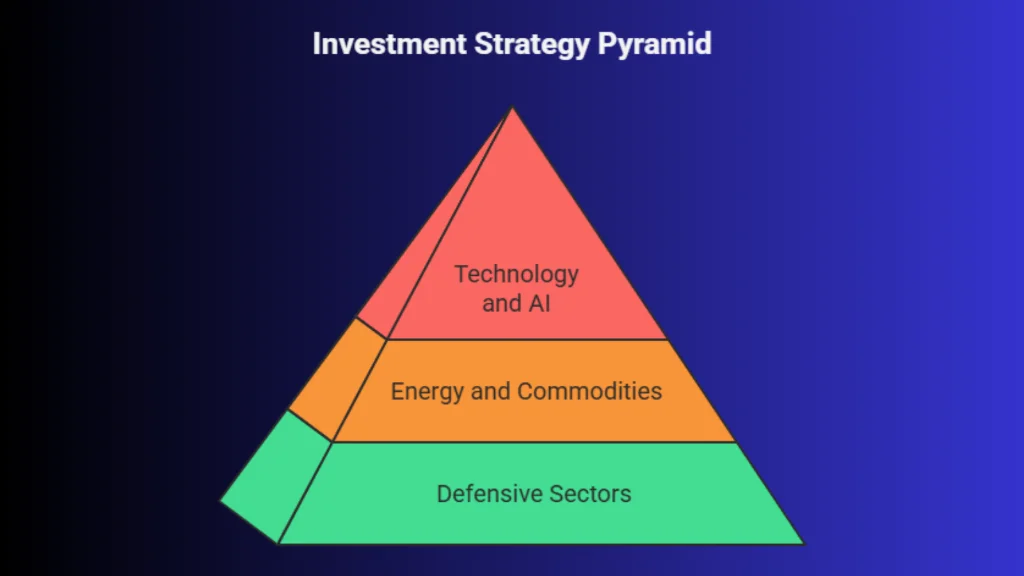 Not all sectors react to global politics on the stock market in the same way. Understanding these nuances is vital when you decide to rebalance your portfolio.
1. Technology and AI
The tech sector is highly sensitive to export restrictions and intellectual property laws. In 2025, we saw major players experience single-day market cap losses of hundreds of billions following breakthroughs in competing regions that were subject to trade restrictions. This highlights the fragility of tech valuations in a fractured political world.
2. Energy and Commodities
Wars in oil-producing regions lead to immediate price spikes. When you see tensions rising in the Middle East or Eastern Europe, it is often a signal to rebalance your portfolio toward energy or gold-related assets, which act as a hedge against inflation.
3. Defensive Sectors
FMCG (Fast-Moving Consumer Goods), healthcare, and utilities tend to remain stable regardless of the political climate. These sectors provide the "ballast" for your investment ship during a political storm.
Tactical Strategies for Institutional Investors
Managing the impact of global politics on the stock market requires a shift from reactive to proactive management.
Step 1: Geopolitical Stress Testing
Investors should conduct regular "what-if" scenarios. What happens to your returns if a major trade route is blocked? What if a specific currency devalues by 15%? Stress testing ensures that when you rebalance your portfolio, you are doing so based on data-driven thresholds rather than headlines.
Step 2: Tracking FII and FPI Outflows
In emerging markets, foreign institutional investors (FIIs) are often the first to pull money during global tensions. This triggers a weaker local currency and increased import costs. Monitoring these flows is a leading indicator for when it is time to rebalance your portfolio.
Note: Behavioral finance shows that investors feel the pain of a loss 2.5 times more than the joy of a gain. Maintaining a long-term perspective is essential to avoid the "herd mentality" that often follows political news.
Future Outlook: Navigating 2026 and Beyond
As we move further into 2026, the relationship between global politics on the stock market will likely become even more complex. The "rewiring" of globalization, moving from cost-efficiency to supply-chain security, means that volatility is the new baseline.
To stay ahead, institutional players must treat geopolitics as a core market driver. By choosing to rebalance your portfolio at least quarterly, you ensure that your asset allocation remains aligned with your risk tolerance, regardless of who holds power in the world's capitals.
If you want to manage market risk and rebalance your portfolio to handle political uncertainty, log in to your discvr.ai account today. Learn how Loan Against Mutual Funds (LAMF) allows investors to access liquidity without disrupting long-term investments during volatile market conditions.