When you look at the landscape of modern investing, it is easy to get swept up in the digital buzz of stocks, crypto, and complex derivatives. However, the most seasoned investors often return to the basics to find true security.
Using gold and silver together is not an outdated strategy; it is a time-tested portfolio diversification approach that combines wealth protection with growth potential. Gold has traditionally served as a haven during economic instability, while silver offers strong upside due to its industrial demand.
In 2026, investors also have the advantage of modern investment tools like digital gold and digital silver, which make owning precious metals easier, more flexible, and accessible than ever before. By combining traditional principles with digital investment platforms, individuals can create a balanced strategy that protects wealth while taking advantage of market opportunities.
Understanding how gold and silver complement each other is the key to building a stable and resilient portfolio.
Why Precious Metals Matter in the 2026 Economy
The global economic environment in 2026 highlights the importance of tangible assets. Rising inflation, increasing global debt, fluctuating currencies, and geopolitical tensions have reminded investors that traditional paper assets alone may not provide enough security.
Precious metals stand out because they are real assets with intrinsic value. Unlike fiat currencies, they cannot be printed or devalued by central banks. For thousands of years, gold and silver have maintained their role as stores of value.
Today, their importance has expanded even further.
Gold continues to serve as a monetary hedge during periods of economic uncertainty. Central banks around the world are still accumulating gold reserves as a safeguard against financial instability.
Silver, on the other hand, has become a critical industrial metal. It plays an essential role in modern technology, including solar energy systems, electric vehicles, electronics, and advanced medical devices.
By investing in both metals, investors gain exposure to two powerful economic forces:
Gold protects wealth during financial crises.
Silver benefits from industrial growth and technological expansion.
This combination creates a diversified strategy capable of performing across multiple economic cycles.
The Strategic Synergy of Gold and Silver
 True stability in investing rarely comes from relying on a single asset. Instead, stability is achieved when different assets balance each other during changing market conditions.
Gold and silver demonstrate this concept perfectly.
Gold is widely recognized as the ultimate store of value. Its price tends to rise when investors become cautious or when financial markets face uncertainty. Because of its long history as a monetary asset, gold remains a preferred safe haven.
Silver has a more dynamic role. It is both a precious metal and an industrial commodity. This dual nature means that silver’s price is influenced by both investment demand and industrial activity.
When global manufacturing and technology sectors expand, demand for silver rises significantly. During these periods, silver often outperforms gold in terms of price growth.
During economic downturns, however, investors shift toward gold for stability.
This interaction between the two metals creates a natural balance. When one metal slows down, the other often strengthens.
As a result, combining them within a portfolio helps reduce volatility and improve long-term resilience.
Gold vs Silver: Understanding Their Roles
Although gold and silver belong to the same asset class, their behavior in financial markets differs in several important ways.
Gold is primarily driven by factors such as:
Central bank purchases
Inflation expectations
Currency fluctuations
Geopolitical risk
Silver, in contrast, responds strongly to:
Industrial demand
Technological development
Renewable energy expansion
Manufacturing growth
Another important difference is volatility.
Silver is generally two to three times more volatile than gold. While this volatility may appear risky, it also creates opportunities for higher returns during strong economic cycles.
Gold, by comparison, moves more steadily and acts as a stabilizing asset within a diversified portfolio.
The Importance of the Gold-to-Silver Ratio
One of the most useful tools for managing precious metal investments is the Gold-to-Silver Ratio (GSR).
This ratio indicates how many ounces of silver are required to buy one ounce of gold.
For example:
If gold is priced at $2,400 per ounce and silver is priced at $30 per ounce, the ratio would be 80:1.
Historically, the ratio has fluctuated widely. Investors often use it to determine whether one metal is undervalued relative to the other.
When the ratio rises above 80, silver is often considered undervalued compared to gold.
When the ratio falls below 50, gold may be relatively cheaper.
Investors can use this ratio as a guide to rebalance their precious metal holdings without leaving the asset class entirely.
How to Use the Gold-to-Silver Ratio
A practical way to apply the ratio in portfolio management is through periodic rebalancing.
When the ratio is high, investors may allocate more capital toward silver. This approach takes advantage of silver’s potential to catch up with gold in price.
When the ratio falls significantly, shifting some holdings from silver into gold helps secure profits while increasing stability.
Reviewing the ratio once or twice a year can help maintain a balanced strategy while capturing market opportunities.
Building the Right Precious Metals Allocation
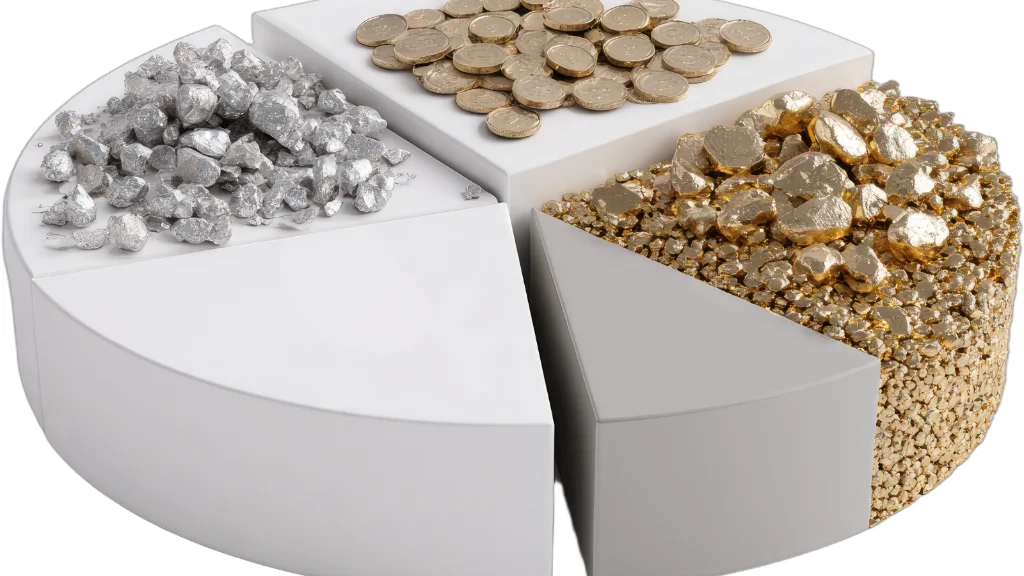 There is no universal allocation that works for every investor. However, financial planners often recommend allocating 5% to 15% of total investment assets to precious metals.
Within that allocation, investors can determine how to divide their holdings between gold and silver based on their risk tolerance.
A commonly recommended structure is the 70/30 model.
In this model:
70% of the metals allocation is invested in gold for stability.
30% is invested in silver to capture growth potential.
Investors with higher risk tolerance may prefer a 50/50 allocation, which increases exposure to silver’s price movements.
More conservative investors may choose an 80/20 split, prioritizing gold’s defensive characteristics.
The Rise of Digital Gold and Digital Silver
One of the most significant developments in precious metals investing is the emergence of digital gold and digital silver platforms.
Traditionally, investors had to purchase physical coins or bars and arrange for safe storage. While physical metals offer security, they also involve storage costs, insurance requirements, and liquidity challenges.
Digital metals solve many of these problems.
Digital gold and digital silver allow investors to purchase small quantities of metal online through mobile apps or investment platforms. Each unit purchased is typically backed by physical metal stored in insured vaults.
This approach offers several advantages.
Investors can start with very small amounts, sometimes as low as ₹100.
Buying and selling transactions are quick and convenient.
There is no need to worry about storage or purity verification.
Investments can be tracked easily through digital dashboards.
For many modern investors, digital metals provide the ideal balance between convenience and security.
Investment Methods and Long-Term Benefits of Combining Gold and Silver
Investors today have several ways to gain exposure to precious metals such as gold and silver. Each method offers different advantages depending on the investor’s financial goals, risk tolerance, and investment horizon. At the same time, combining both metals in a portfolio can create a balanced strategy that protects wealth while still offering growth opportunities.
Physical bullion remains the most traditional form of investment. Coins and bars provide direct ownership of the metal and independence from financial institutions. Many investors value the sense of security that comes from holding a tangible asset. However, physical metals also require safe storage, insurance, and often involve higher purchase premiums.
 Exchange-traded funds (ETFs) offer a more modern approach. These funds track the market price of gold or silver and are traded on stock exchanges. Investors can easily buy or sell ETF units through a brokerage account during market hours. ETFs are highly liquid and convenient, but investors do not directly own the physical metal.
Digital gold and digital silver have become increasingly popular in recent years. These platforms allow investors to buy small quantities of metals online through mobile apps or financial platforms. The purchased metal is typically backed by physical reserves stored in professional vaults. Digital metals allow fractional investing, easy tracking, and instant liquidity without the need for a trading account.
Many investors choose to use a combination of these methods. For example, physical metals can be held as a long-term wealth reserve, while digital gold and silver can be used for regular investments or portfolio rebalancing.
Combining gold and silver within these investment methods creates what many experts call a barbell strategy. This approach balances stability with growth potential, making it useful for long-term portfolio management.
Portfolio Stability: Gold acts as a stabilizing asset during financial uncertainty, inflation, or market downturns.
Growth Potential: Silver offers higher price movement and can deliver strong gains during periods of industrial expansion.
Inflation Protection: Both metals have historically protected purchasing power when currencies weaken or inflation rises.
Diversification Advantage: Holding both metals reduces reliance on a single asset class and spreads risk across different market drivers.
Industrial Demand for Silver: Silver’s use in electronics, solar panels, and electric vehicles creates strong long-term demand.
Safe-Haven Value of Gold: Gold continues to be a trusted store of value during geopolitical tensions and economic instability.
Flexible Investment Options: Investors can choose between physical metals, ETFs, or digital platforms based on convenience and strategy.
Balanced Risk and Return: Gold provides stability while silver introduces growth potential, creating a well-balanced investment structure.
By combining different investment methods and allocating funds across both metals, investors can build a portfolio that remains resilient during economic changes while still benefiting from long-term market opportunities.
Conclusion
Gold and silver have maintained their value for thousands of years, making them two of the most reliable assets in financial history. In the modern investment world, combining these metals within a diversified portfolio provides both stability and growth potential.
Gold acts as a safeguard against inflation, currency instability, and geopolitical uncertainty. Silver complements this stability with strong demand from emerging technologies and renewable energy industries.
With the availability of digital gold and digital silver, investors now have convenient ways to incorporate these metals into their portfolios without dealing with storage challenges.
By maintaining a disciplined allocation, monitoring the gold-to-silver ratio, and investing consistently over time, individuals can build a portfolio that remains resilient across economic cycles.
Ultimately, the goal of financial planning is not just short-term gains but long-term stability. Strategies like loans against mutual funds (LAMF) allow investors to access liquidity while keeping their investments intact, helping them preserve wealth, manage risk, and maintain financial flexibility in an unpredictable world.