
As a parent in India, one of your biggest dreams is likely seeing your child graduate from a prestigious institution. Whether it is an IIT, a top-tier medical college, or a business school abroad, the pride of that moment is unmatched. However, the reality of rising costs can be a bit of a wake-up call. With education inflation in India trending between 10% and 12% annually, the amount you see on a brochure today will likely double or triple by the time your child is ready to enroll.
This is why child education planning is not just a financial task but a commitment to your child’s future freedom. When you take the time to start a college savings plan early, you are not just accumulating wealth; you are buying your child the ability to choose their career based on passion rather than price tags. Let’s look at how you can build a solid foundation for their dreams without losing your peace of mind.
Why Early Child Education Planning is a Game Changer?
In finance, time is more valuable than the amount of money you invest. In India, we often wait for a "big chunk" of money to start investing, but the secret to successful child education planning lies in small, consistent steps. When you start early, your money has more time to ride out the ups and downs of the Indian stock market.
Consider this: a parent who begins a Systematic Investment Plan (SIP) the day their child is born can build a significant corpus with half the effort of someone who waits until the child is ten. Compounding works like a snowball effect. The more time you give your college education savings, the less "heavy lifting" your monthly budget has to do. It is about working smarter, not harder, to secure that degree.
Practical Steps to Start a College Savings Plan
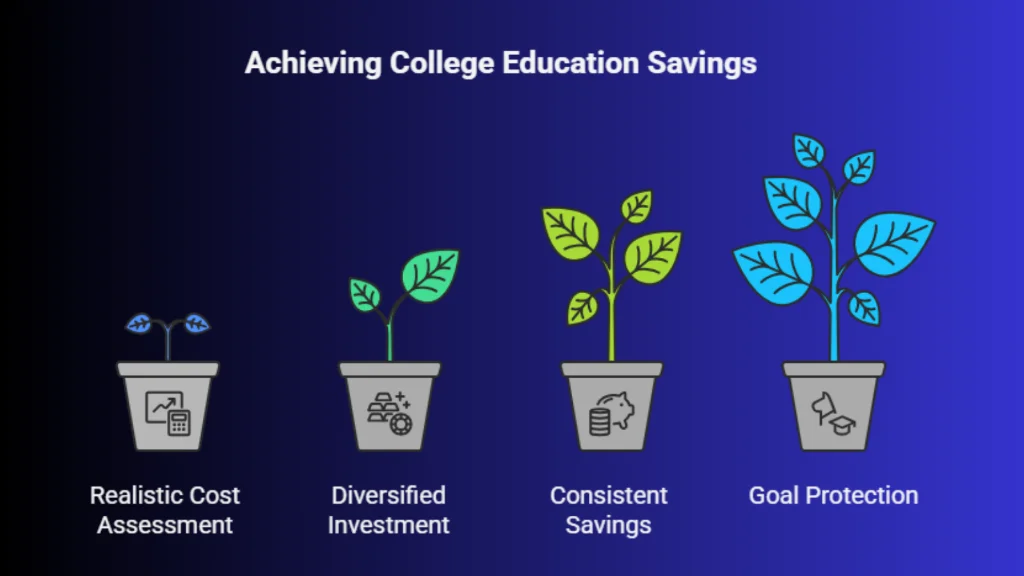 If you are feeling overwhelmed, the best way to move forward is to break the process into manageable steps. You do not need to be a financial expert to start a college savings plan that actually works.
Be Realistic About Costs: Look at the current fees of the course you have in mind. If an MBA costs ₹20 lakh today, factor in a 10% annual increase. In 15 years, that same course could cost over ₹80 lakh.
Pick Your Investment Mix: Do not put all your eggs in one basket. A mix of equity for growth and government schemes for safety is usually the best path for child education planning.
Prioritize Consistency: It is better to save ₹5,000 every single month than to save ₹50,000 once a year. Consistency is what builds the habit of college education savings.
Protect the Goal: Ensure you have adequate term insurance. If something happens to you, the insurance payout should be enough to fund the education you planned for.
Comparing Top Investment Avenues in India
India offers unique investment opportunities that cater specifically to families. Choosing the right mix for your college education savings depends on your risk tolerance and your child's age.
Investment Tool | Why Choose It? | Risk Level | Ideal Timeline |
Equity Mutual Funds | To beat education inflation over the long term. | Moderate to High | 10 to 18 Years |
Sukanya Samriddhi (SSY) | High, tax-free interest for a girl child. | Very Low | 15 to 21 Years |
Public Provident Fund (PPF) | Safe, tax-efficient, and backed by Govt. | Very Low | 15 Years |
Gold ETFs/Bonds | A traditional hedge against currency drops. | Moderate | 5 to 10 Years |
Maximizing Equity for College Education Savings
 For most Indian families, traditional savings like Fixed Deposits (FDs) are a comfort zone. However, if your goal is 10 or 15 years away, an FD might actually lose value after you account for inflation and taxes. This is where equity comes into your child's education planning strategy.
By using Diversified Equity Mutual Funds, you are essentially owning a piece of India’s growth. While the market can be bumpy in the short term, historically, it has been the best way to grow college education savings significantly. When you start a college savings plan via a SIP, you don't have to worry about "timing the market." You simply keep investing, and over time, the power of compounding takes over.
Utilizing Government Schemes: SSY and PPF
If you have a daughter, the Sukanya Samriddhi Yojana (SSY) is perhaps the best gift you can give her. It is a dedicated part of child education planning that offers a higher interest rate than most other debt options and comes with the "Exempt-Exempt-Exempt" tax status. This means the money you put in, the interest earned, and the final amount are all tax-free.
For those with sons or those looking for additional safety, the PPF remains a sturdy pillar for college education savings. It provides a disciplined way to save and ensures that a portion of your child’s fund is completely protected from market volatility. When you start a college savings plan, balancing these safe options with equity is the hallmark of a professional strategy.
The Importance of the "Glide Path" Strategy
As your child gets closer to their 18th birthday, your strategy for child education planning must change. You cannot afford a market crash three months before a tuition bill is due.
In the early years, focus on growth. But once your child reaches the age of 15, you should start moving your college education savings from risky equity funds into safer liquid funds or short-term deposits. This "glide path" ensures that the money you worked so hard to save is available and liquid precisely when the admission letters start arriving. Professional child education planning is as much about protecting your gains as it is about making them.
Why You Shouldn't Ignore Your Own Retirement
 It sounds harsh, but you must put on your own oxygen mask first. One of the most common mistakes parents make when they start a college savings plan is stopping their own retirement contributions.
Remember, your child can get a student loan to bridge a gap in college education savings, but no bank will give you a loan for your retirement. A healthy financial plan for a family involves balancing both. If you are financially independent in your old age, you are giving your child the greatest gift of all: the freedom to use their own income to build their life, rather than supporting yours.
Bottom Line
Many families are sold "Child Education Plans" that promise both insurance and investment. In reality, these often have high commissions and lower returns than a simple combination of a Term Plan and a Mutual Fund.
To professionally start a college savings plan, keep your insurance and your investments separate. Use a Term Insurance policy to cover the "what if" scenarios, and use direct investments to grow your college education savings. This approach is transparent, cheaper, and usually results in a much larger corpus for your child’s university fees.
If you’re planning to start a college savings plan or an SIP for your child’s education, explore goal-based investment options and build a structured plan for their academic future, while using Loan Against Mutual Funds (LAMF) to access funds when needed without disturbing long-term investments.