
ETFs (Exchange-Traded Funds) and mutual funds are two of the most common ways investors gain diversified exposure to markets. Both pool money from many investors and invest across a basket of stocks, bonds, or other assets. The difference lies in how they are structured and how investors interact with them.
ETFs trade on stock exchanges, much like individual shares. This means you can buy or sell them throughout the trading day at market prices. ETFs are often low-cost, highly transparent, and tax-efficient, which makes them appealing for long-term investors who want flexibility and control. Most ETFs follow an index and aim to match market performance rather than beat it.
Mutual funds, on the other hand, are bought and sold directly through the fund company. All transactions happen once per day at the fund’s Net Asset Value. Mutual funds are popular for retirement accounts and systematic investing because they allow automatic contributions and reinvestment without active decision-making. When you start investing early, even small and regular contributions can build significant wealth over the long term.
Choosing between ETFs and mutual funds depends on your goals. ETFs suit investors who value flexibility and lower taxes, while mutual funds work well for disciplined, hands-off investing.
What Are ETFs and Mutual Funds?
ETFs are investment funds traded on stock exchanges, similar to stocks. They typically track an index like the Nifty 50 or Sensex, and their prices change throughout the day. Mutual funds pool investors’ money and are actively managed by professional fund managers.
They are bought or sold based on the Net Asset Value (NAV), which is calculated at the end of the trading day. The biggest advantage of choosing to start investing early is that you reduce pressure later and stay focused on long-term financial goals.
Key Differences to Consider
Before choosing between ETFs and mutual funds, it is important to understand the practical differences that affect how your money grows over time. While both offer diversification and professional management, they vary in areas such as costs, trading flexibility, tax treatment, and ease of investing.
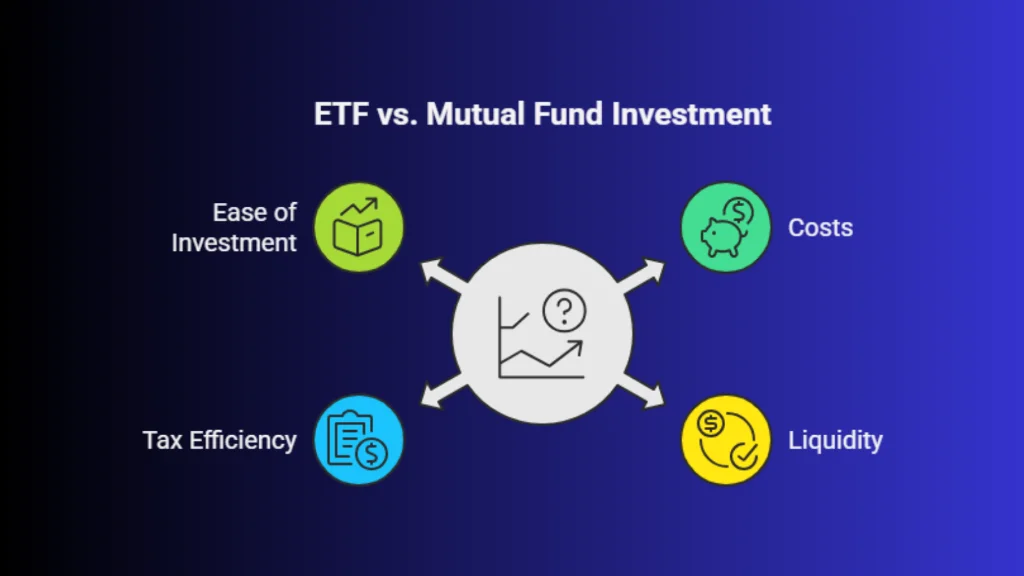 These factors may seem small at first, but over the long term, they can significantly influence returns and investor behavior. Reviewing these key differences will help you align your investment choice with your financial goals, risk tolerance, and preferred level of involvement.
1. Costs and Fees
ETFs usually have lower expense ratios because they are passively managed, while mutual funds typically carry higher fees due to active management. Lower costs in ETFs can boost long-term returns, making them more appealing for cost-conscious investors.
2. Liquidity and Flexibility
ETFs offer more flexibility as they can be bought or sold throughout the day at real-time prices, which is ideal for investors looking to react to market movements. Mutual funds, however, are traded at the day’s NAV, limiting your ability to make quick decisions.
3. Tax Efficiency
ETFs tend to be more tax-efficient because they don’t trigger capital gains taxes as often as mutual funds. Mutual funds, on the other hand, may distribute taxable capital gains when the fund manager buys or sells securities within the fund.
4. Ease of Investment
For beginners, mutual funds are easier to invest in. Systematic Investment Plans (SIPs) allow you to start with small recurring purchases, making mutual funds a great choice for those looking to invest consistently without managing the day-to-day market movements. In contrast, ETFs require a demat and trading account, which can be more complex for beginners.
Which Should You Choose?
Choosing between ETFs and mutual funds is not about finding a better product. It is about selecting the structure that best fits how you invest, how often you monitor markets, and how much control you want over your decisions.
 Both options can support long-term wealth creation, but they serve different investor mindsets. Understanding your goals, time horizon, and level of involvement will help you make a confident choice.
For investors who prefer consistency and automation, mutual funds offer a simple and disciplined approach. For those who want flexibility and lower ongoing costs, ETFs provide greater control and efficiency. The sections below break this down in detail.
Factor | Mutual Funds | ETFs |
Best suited for | Long-term, hands-off investors | Active or experienced investors |
Investment approach | Systematic and disciplined | Flexible and market responsive |
Ideal time horizon | Long-term wealth building | Short-term to long-term strategies |
Investment method | SIP and lump sum | Lump sum and tactical trades |
Trading frequency | Once per day at NAV | Throughout the trading day |
Market reaction | No reaction to intraday moves | Can react to real-time price changes |
Cost structure | Higher on average | Generally lower expense ratios |
Tax efficiency | Moderate, depends on turnover | High due to structural advantages |
Automation | Easy to automate investments | Requires manual or broker setup |
Investor involvement | Minimal monitoring needed | Requires active tracking |
Conclusion
Both ETFs and mutual funds play an important role in long-term investing, and the right choice depends on how you prefer to invest. ETFs offer flexibility, lower fees, and greater control, making them suitable for investors who are comfortable tracking markets and making timely decisions.
Mutual funds, on the other hand, support a more automated and disciplined approach, which helps investors stay consistent and focused on long-term goals. There is no single correct option for everyone.
Many investors benefit from using a combination of both to balance efficiency and simplicity. Log in to your account to start investing early, stay consistent, and select investments that align with your financial goals and risk tolerance.