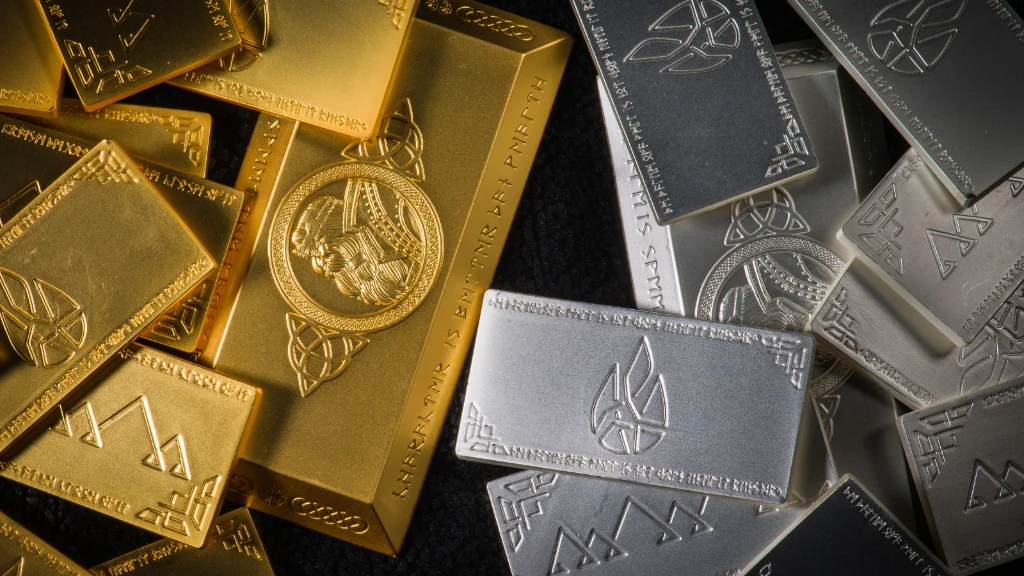
When protecting your wealth against economic shifts, the question often boils down to two heavy hitters: silver and gold. Both have been used as money for millennia, and both offer a sanctuary when paper currencies lose their grip.
However, in the fast-paced market of 2026, the choice between silver vs gold hedge strategies has become more nuanced.
While gold remains the ultimate safe haven for central banks, silver is carving out a massive niche as an essential industrial powerhouse, making it a favorite for those who want to invest in silver for growth as much as for safety.
Silver vs Gold Hedge
Understanding the fundamental difference between these two metals is the first step toward building a resilient portfolio. Gold is almost entirely a monetary asset; people buy it when they are scared of inflation or geopolitical unrest. It doesn't corrode, it is easily divisible, and it carries high value in a tiny footprint. Silver, while also a precious metal, has a split personality. It is increasingly viewed as a "green" metal because it is indispensable for the solar and electric vehicle sectors.
Because of this dual nature, silver often reacts differently to the economic cycle than gold. If the economy is growing, silver demand spikes because of manufacturing needs. If the economy is crashing, silver can suffer from a drop in industrial demand even while its "precious metal" side tries to push the price up. Gold, by contrast, is much more singular in its purpose; it is the world’s oldest insurance policy against financial failure.
Criteria | Gold | Silver |
Primary Role | Monetary hedge and store of value | Dual role: precious metal + industrial commodity |
Core Demand Driver | Inflation protection, currency stability, geopolitical risk | Industrial usage and green energy transition |
Economic Cycle Sensitivity | Performs best during recessions and crises | Performs best during economic expansion |
Volatility | Low to moderate | High |
Risk Profile | Defensive, capital preservation focused | Aggressive, growth-oriented |
Liquidity | Extremely high and globally accepted | High but more market-driven |
Use by Central Banks | Actively accumulated as reserves | Not held as reserves |
Performance in Bull Markets | Steady upward moves | Higher percentage gains (high beta) |
Downside Risk in Crashes | Acts as a shock absorber | Can decline due to falling industrial demand |
Accessibility | Higher cost per ounce | Lower cost per ounce |
Best Suited For | Long-term wealth protection and stability | Investors seeking upside with volatility |
Portfolio Role | Insurance against systemic risk | Tactical growth hedge within metals allocation |
Strategic Allocation and Market Data
 For those balancing a professional portfolio, the decision isn't usually "either/or," but rather "how much of each." As of early 2026, market analysts have observed a significant shift in how these metals are being utilized.
Professional traders often use the gold-to-silver ratio to decide when to switch between the two. This ratio tells you how many ounces of silver you need to buy one ounce of gold.
Historically, when the ratio is high (above 80:1), silver is considered "cheap" relative to gold. When the ratio drops (as it has in early 2026 toward 50:1), it indicates that silver has been running hot. Monitoring this ratio helps you rebalance your portfolio without needing to time the broader market.
Unlike gold, which is mostly stored in vaults, silver is "consumed" in industrial processes. While some of it is recycled, a significant portion of the silver used in electronics and solar cells is never recovered.
We are currently in the sixth consecutive year of a silver supply deficit. This means that every ounce of silver you buy is competing with a tech company that needs it to manufacture its products, creating a supply-demand squeeze that favors the investor.
Feature | Gold (The Anchor) | Silver (The Rocket) |
Primary Value Driver | Central Bank Demand | Industrial/Tech Demand |
Typical Volatility | 10% – 15% Annualized | 25% – 40% Annualized |
Industrial Usage | Less than 10% | Over 55% |
2025 Returns | ~64% | ~145% |
2026 Price Target | $6,100 – $7,000/oz | $175 – $220/oz |
Modern Ways to Own and Manage Precious Metals
 Precious metals like gold and silver play a critical role in protecting portfolios against inflation, currency risk, and market instability. Modern investors are no longer limited to storing coins in a locker; today’s ecosystem offers multiple ownership structures that balance security, liquidity, growth potential, and operational ease.
Equally important is how these assets are managed over time, as volatility, taxation, and allocation drift can materially affect outcomes. A well-structured precious metals strategy combines the right ownership vehicles with disciplined portfolio management.
Own physical bullion for maximum security: Holding gold or silver coins and bars provides direct ownership with zero counterparty risk. This method is best suited for long-term capital preservation and systemic risk protection.
Use professional vaulting for scale and safety: High-security, insured vaulting services allow large investors and businesses to own physical metal without dealing with storage, insurance, or logistics complexities.Invest through ETFs for convenience and liquidity: Exchange-traded funds provide exposure to physical metals within a brokerage account, offering easy entry, exit, and transparent pricing.
Evaluate ETF costs and structure carefully: Expense ratios and fund structures impact long-term returns, making it essential to choose physically backed, low-cost ETFs.
Add mining stocks for leveraged upside: Mining companies amplify metal price movements, offering higher return potential but introducing operational and regulatory risks.
Diversify exposure across ownership types: Combining physical metals, ETFs, and selective miners reduces dependence on any single risk factor.
Anchor portfolios with gold for stability: Gold’s lower volatility and monetary role make it the foundation of most precious metals allocations.
Use silver strategically for growth: Silver’s industrial demand and higher volatility provide upside potential during economic expansions and metal bull cycles.
Rebalance regularly to control allocation drift: Periodic rebalancing, such as maintaining a 75% gold and 25% silver mix, helps lock in gains and manage risk.
Plan for tax and regulatory efficiency: Tax treatment varies by jurisdiction, with gold and silver often treated differently, making professional tax guidance essential.
Together, disciplined ownership and proactive management transform precious metals from a passive hedge into a strategic portfolio asset.
Conclusion
Both gold and silver offer unique advantages as a hedge, but they serve different psychological and financial purposes. Gold is the foundation of a conservative strategy, offering unmatched stability and global trust. Silver is the engine of a growth-oriented strategy, tapping into the technological and industrial revolutions that are defining the 2020s. By combining both, you create a "barbell" effect: one metal protects you from the downside, while the other captures the upside of a changing world.
As you look to refine your investment approach, having the right data is everything. If you want to dive deeper into market signals and automated insights to help you decide when to pull the trigger on your next trade, explore discvr.ai . Our platform bridges the gap between complex market movements and actionable intelligence, ensuring your portfolio stays ahead of the curve. Would you like me to analyze a specific metal's performance against your current stock holdings?