Turn claim and trade documents into decisions, not a growing backlog.
For insurance claims teams and trade operations handling high-volume motor, health, customs, and broker document queues - where humans manually read, validate, and cross-reference before every decision.

Who it's for
Insurance companies and motor/health insurers running high-volume claims where teams manually review forms, survey reports, garage invoices, and medical documents. Also importers, traders, and customs brokers handling customs entries, broker invoices, bills of lading, and compliance packs before clearance or payment.
Typically championed by
The shift
Claims teams spend a significant share of their time collecting, reading, validating and cross-referencing information across unstructured documents, claim forms, motor survey reports, garage invoices, discharge summaries, before a claim can even move forward. Formats differ by garage, hospital, surveyor and customer, so processors manually extract and reconcile the same fields case after case. The result is a repetitive, high-cost workflow, longer turnaround, and more customer follow-ups than the process should need.
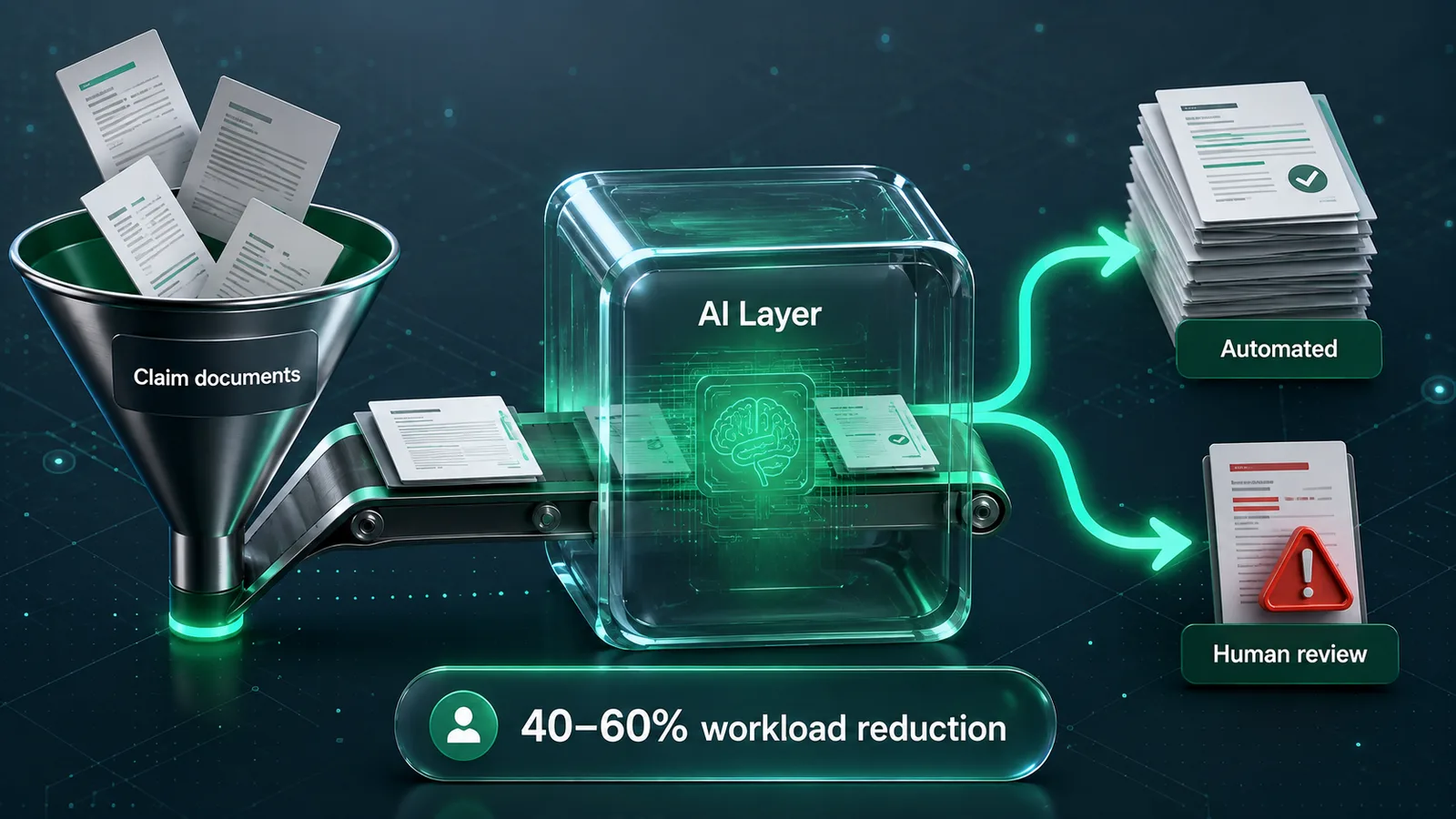
Framed as an expected outcome, not a validated client metric (pre-pilot): claims teams spend less time on manual document review and cross-referencing, with more of their time going to genuine exceptions and liability decisions. Early estimates point to a 40-60% reduction in manual document-processing workload, an industry-informed estimate rather than a measured result, with validated numbers to follow real pilot deployments.
How it works
Reads and interprets claim documents (forms, motor survey reports, garage invoices, medical packs) and trade/customs documents (customs entries, broker invoices, bills of lading, packing lists) - standardises fields, flags discrepancies, runs policy and compliance validation, and produces confidence-scored recommendations. Low-confidence cases route to human review.
- Step 1
Evidence In
Claim forms, motor survey reports, garage estimates/invoices and medical documents (discharge summaries, bills, reports) are read directly, in whatever format they arrive.
- Step 2
AI Interpretation
Extracts and standardises key fields, customer, policy and incident details, damage descriptions, billed amounts, diagnosis and treatment, across every document.
- Step 3
Validation & Confidence Scoring
Cross-references documents against each other and against policy and business rules, then generates a confidence score for every extracted field.
- Step 4
Recommendation & Routing
A structured recommendation reaches the claims officer; low-confidence or inconsistent cases route to human review, high-confidence cases move straight to the decision queue.
Trust & governance
AI assists, humans decide
AI assists in document understanding and recommendation generation; final liability and claim approval decisions remain with human claims officers.
Confidence-scored, not black-box
Confidence scores indicate certainty for every extracted field.
Traceable and fully auditable
Every extracted field traces back to its source document, and every AI recommendation and human action is fully auditable.
Configurable to your rules
Insurer-specific business rules and workflows are configurable, not one-size-fits-all.
Human-in-the-loop for exceptions
Exceptions and low-confidence cases always route to human review.
Enterprise-grade security
Enterprise-grade security and access controls throughout.
Document-by-document coverage
| Document Type | What the Platform Extracts & Validates |
|---|---|
| Claim Forms | Customer, policy, incident and claim details; validates mandatory fields and flags missing information. |
| Motor Survey Reports | Assessor observations, damage descriptions, recommended repairs, parts involved and severity. |
| Garage Estimates & Invoices | Repair items, labour charges, spare parts, taxes and final billed amounts, compared against survey recommendations and policy limits. |
| Medical Documents | Diagnosis, treatment, hospitalization details, dates, procedures and billed amounts from discharge summaries, bills and reports. |
| Customs Entries & Broker Docs | HS codes, declared values, duties, broker fees, and line-item reconciliation against bills of lading and packing lists. |
| Trade Compliance Packs | Certificate of origin, insurance certificates, and regulatory filings - missing fields and cross-document mismatches flagged before clearance. |
Agents deployed for this module
These are the named agents we deploy when Claims Processing Automation is the production module for your business problem. Each agent is a job we deploy for you. You do not buy software and install it yourself.
Insurance Claims Document Agent
Faster claims decisionsTurn claim documents into structured decisions, not backlog.
See how we deploy thisTrade & Customs Document Agent
Lower compliance exposureScreen and reconcile trade documents before compliance exposure hits.
See how we deploy thisYou might also need
Related insights
Document + Image + Video Intelligence: The Missing Layer in Customer Operations
Text-only chatbots break down the moment a case depends on a photo, a scanned document, or a video, not just a ticket description. Real operational efficiency requires extracting and cross-referencing evidence across every format before a case is routed.
Read article · 6 min →BFSIThe Next Cost Takeout Opportunity in BFSI: AI for Back-Office Case Operations
BFSI's AI focus has skewed toward customer-facing chatbots, leaving the bigger cost opportunity, back-office case operations, largely untouched. AI should prepare the case; humans should still apply judgement.
Read article · 6 min →BFSIAI in Dispute and Chargeback Operations: The Unsexy Use Case That Can Save Millions
Dispute and chargeback handling is manual, back-office, and gets little executive attention, which is exactly why it's a large, underexploited AI opportunity. An intelligence layer that reads cases and prepares structured decision cards cuts handling time and revenue leakage without removing human accountability.
Read article · 6 min →Get in touch
Frequently asked questions
Claim forms, motor survey reports, garage estimates and invoices, and medical documents such as discharge summaries, bills and reports, across whatever format your garages, hospitals, surveyors and customers currently send them in.
It reads structured and semi-structured documents, including scanned images. Handwritten content is assessed case by case since accuracy depends on legibility, we'll evaluate this directly against a sample of your own documents during a pilot.
Missing mandatory fields and inconsistencies across documents are flagged automatically rather than silently ignored, and routed for human review before a claim moves forward.
Yes, DiscvrAI builds a decision and execution layer on top of your existing systems rather than replacing them, so it's designed to work alongside whatever claims management system you already run.
They're routed to a claims officer for manual review, arriving with the relevant document evidence and a confidence score already attached, not silently auto-approved.
Yes, business rules and workflows are configurable per insurer rather than fixed.
No, AI assists in document understanding and recommendation generation; final liability and claim approval decisions always remain with your claims officers.
Timelines depend on your document mix and volume, talk to us with a sample of your own claim types and we'll scope a pilot plan.
Yes. The Trade & Customs Document Agent extends the same evidence engine to customs entries, broker documents, and compliance packs - with trade-specific rules and human-in-the-loop clearance decisions.
Insurance Claims Document Agent for motor and health claims, and Trade & Customs Document Agent for import/export documentation - both forward-deployed via DiscvrAI Studio at /studio.